
In order to maintain the child’s interest in reading in a purposeful way, Maria Montessori introduced grammar at the phonetic reading stage. Each time a new part of speech is introduced, it is done through playing a lively game with children!
Farm Game 1 – Phonetic is specifically designed to support children in the early Montessori language curriculum, helping them identify parts of speech through play and hands-on interaction.
One Material, Multiple Montessori Presentations
Our Farm Game 1 brings several classic Montessori grammar presentations together in one complete set. Teachers can use the same farm objects with our prepared color-coded cards to introduce the function of the noun, article, adjective, and verb, as well as reading, vocabulary enrichment, phrase building, and simple sentence construction.
What’s Included
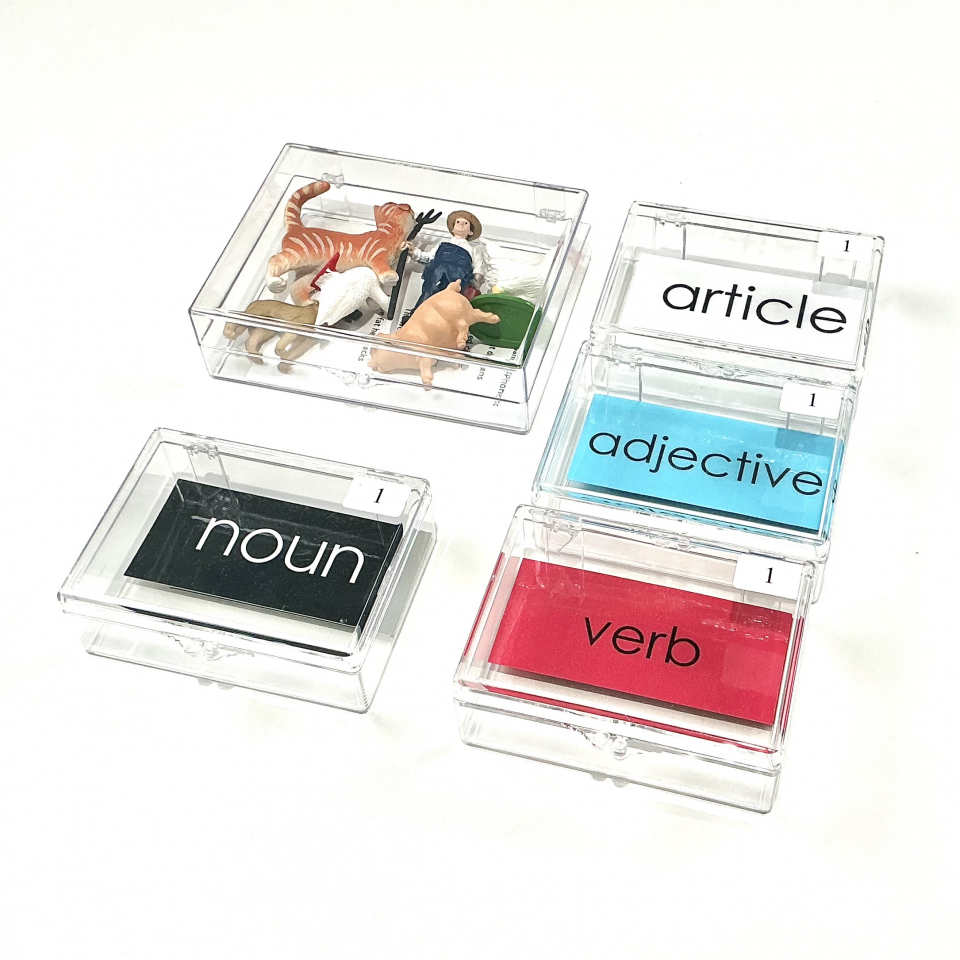
Our unique Phonetic Farm Game includes:
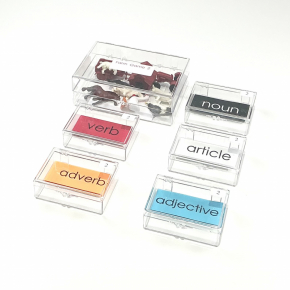
- One large plastic box containing six miniature phonetic objects: pig, man, duck, dog, cat, and hen.
- Noun box: one black heading card labeled Noun and six black noun cards.
- Article box: one white heading card labeled Article and six white article cards.
- Adjective box: one blue heading card labeled Adjective and six blue adjective cards.
- Verb box: one red heading card labeled Verb and six red verb cards.
- Plastic tray.
Dimensions: Small card boxes: 3½” × 2½” × 1½”. Large object box: 4½” × 3½” × 1½”. Word cards: 3” × 1½”. Heading cards: 3½” × 1½”. Tray: 11” × 7½”.
All cards are fully laminated for durability. The professionally sculpted and hand-painted miniature objects range in size from 1.5” to 3”.
This is an excellent Montessori material for introducing grammar while supporting phonetic reading, vocabulary development, phrase building, and sentence construction.
Recommended age: 4+
How We Introduce Grammar to 4-Year-Olds the Montessori Way
A Playful Introduction to Montessori Grammar
At around age 4, once children begin reading phonetic words, Montessori introduces grammar in a structured but playful way. Children do not begin by memorizing rules or definitions. Instead, they discover the function of words through games with familiar objects, conversation, and color-coded word cards. Each time a new part of speech is introduced, it is done through a lively game, giving the child a clear understanding of its function.
For Teachers and Parents
For Montessori teachers, the Farm Game provides a clear sequence of ready-to-use grammar presentations in one material. For parents, it offers an opportunity to understand how children as young as four begin learning grammar in a Montessori classroom through concrete, meaningful, and enjoyable games.
Explore the complete Montessori grammar presentations below.
Introduction to the Noun
Before working with the Farm Game, the teacher presents a playful oral game using familiar objects in the classroom. The teacher asks the children to bring specific objects, such as a book or an insect. Then she asks, “Bring me…” without naming an object.
When the children ask what she wants, the teacher explains that she must name it before they can bring it. Through this game, children discover that every person, animal, place, and object has a name—and these names are nouns.
The Noun – Farm Game
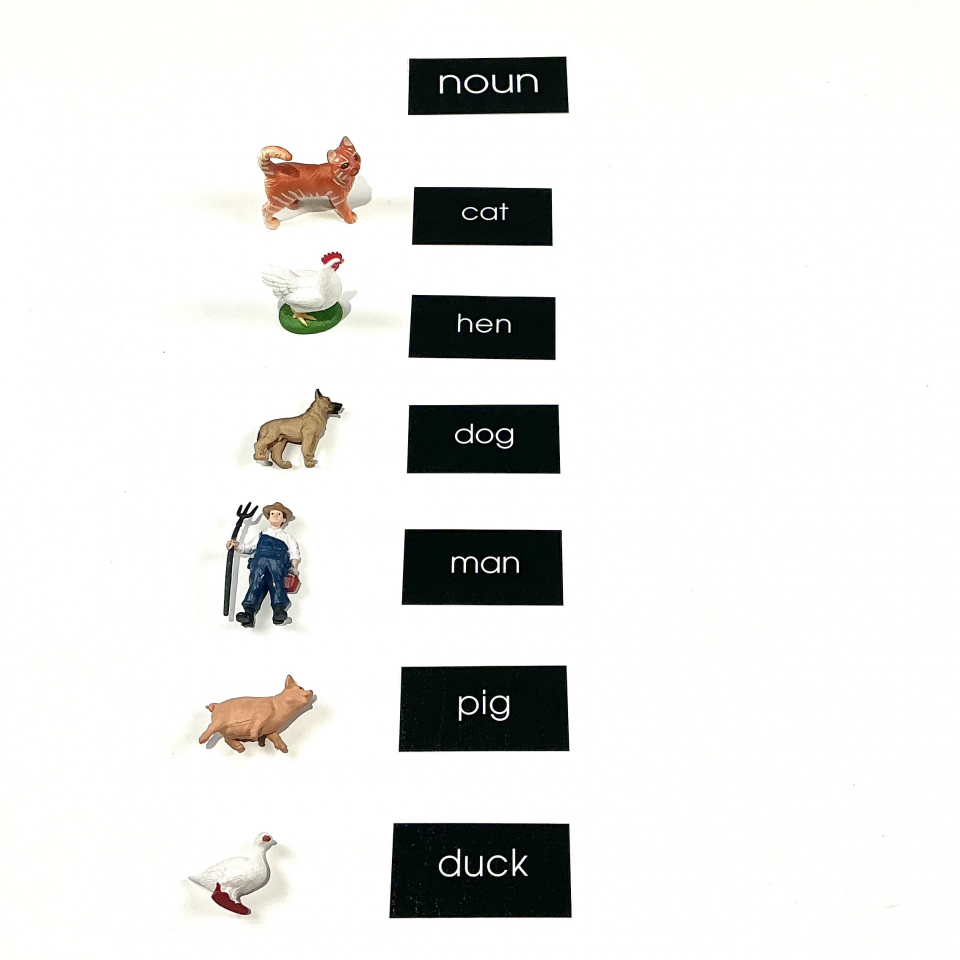
For this presentation, the teacher takes the box containing the farm objects and the Noun box. The teacher removes one object at a time, invites the child to name it, and places it on the table. Once all the objects have been presented, the child takes one black word card at a time from the Noun box, reads it, and places it beneath the corresponding object.
Then, the teacher places the black heading card Noun above the word cards, reads it aloud, and explains that nouns are always represented by black cards in these grammar games.
Singular and Plural
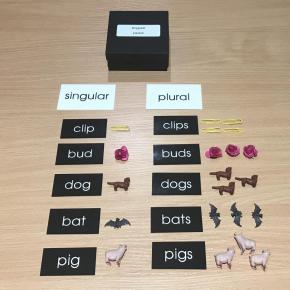
After the child has worked with nouns, the next step is to explore singular and plural forms using our Singular and Plural Exercise.
Introduction to the Article
Before working with the Farm Game cards, the teacher presents a short oral game using a selection of familiar objects. In a playful voice, the teacher asks for “a” or “an” object—one of many—and then asks for “the” object—one particular object.
The game is repeated several times, focusing the child’s attention on the articles. The teacher may then use an article incorrectly and invite the child to notice and correct it. Through natural conversation, the child receives an informal introduction to the function of the article.
The Article – Farm Game
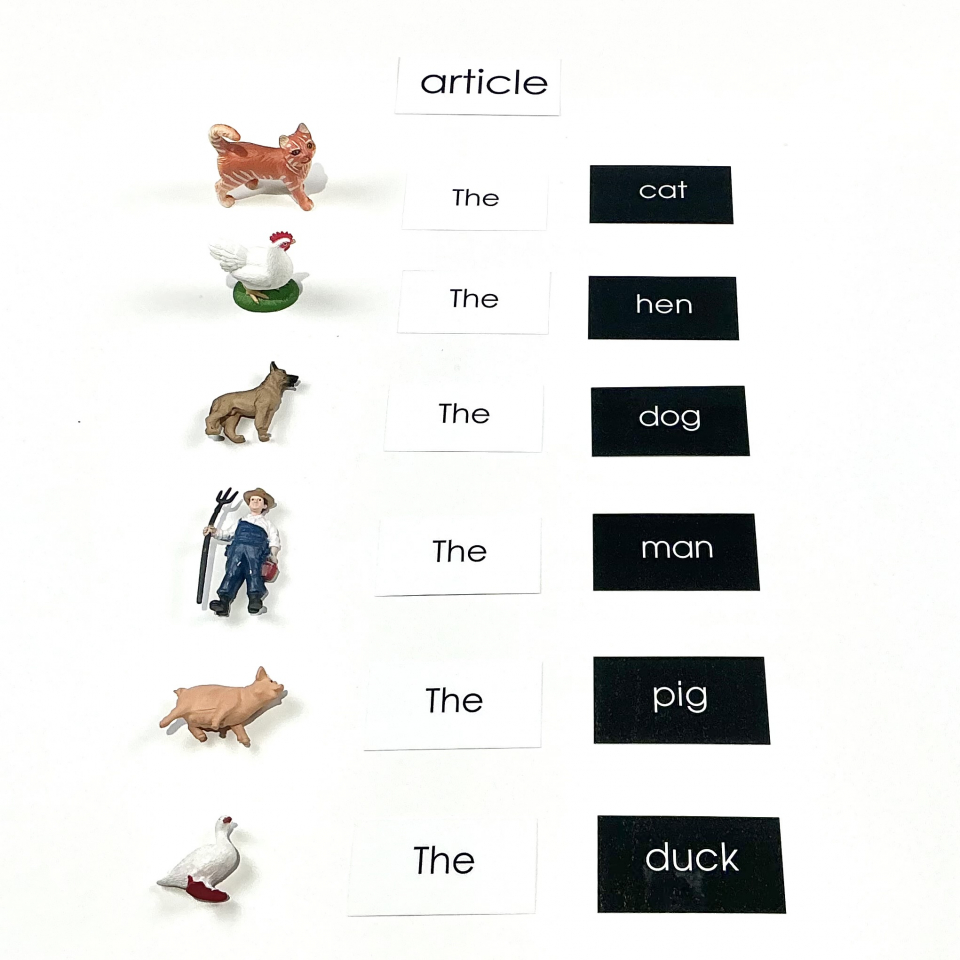
For this presentation, the teacher takes the box containing the farm objects, the Noun box, and the Article box. The child places the objects on the table, reads the black noun cards, and places them beneath the corresponding objects as before.
Then, the teacher introduces the white heading card Article. The child takes one white the card at a time from the Article box, reads it, and places it before the appropriate noun card. The child then reads the complete phrase, such as the pig.
The teacher places the white heading card Article above the article cards and explains that articles are always represented by white cards in these grammar games.
Introduction to the Adjective
Before working with the Adjective cards, the teacher presents a short oral game using several similar objects. In a playful voice, the teacher asks the child to bring one object, for example, “Bring me a pencil.”
Each time the child brings a pencil, the teacher playfully explains that it is not the one she wanted. When only one pencil remains, the teacher says, “Thank you. This is the pencil I wanted—the red pencil.” Through this game, the child receives an informal introduction to the function of the adjective.
The Adjective – Farm Game
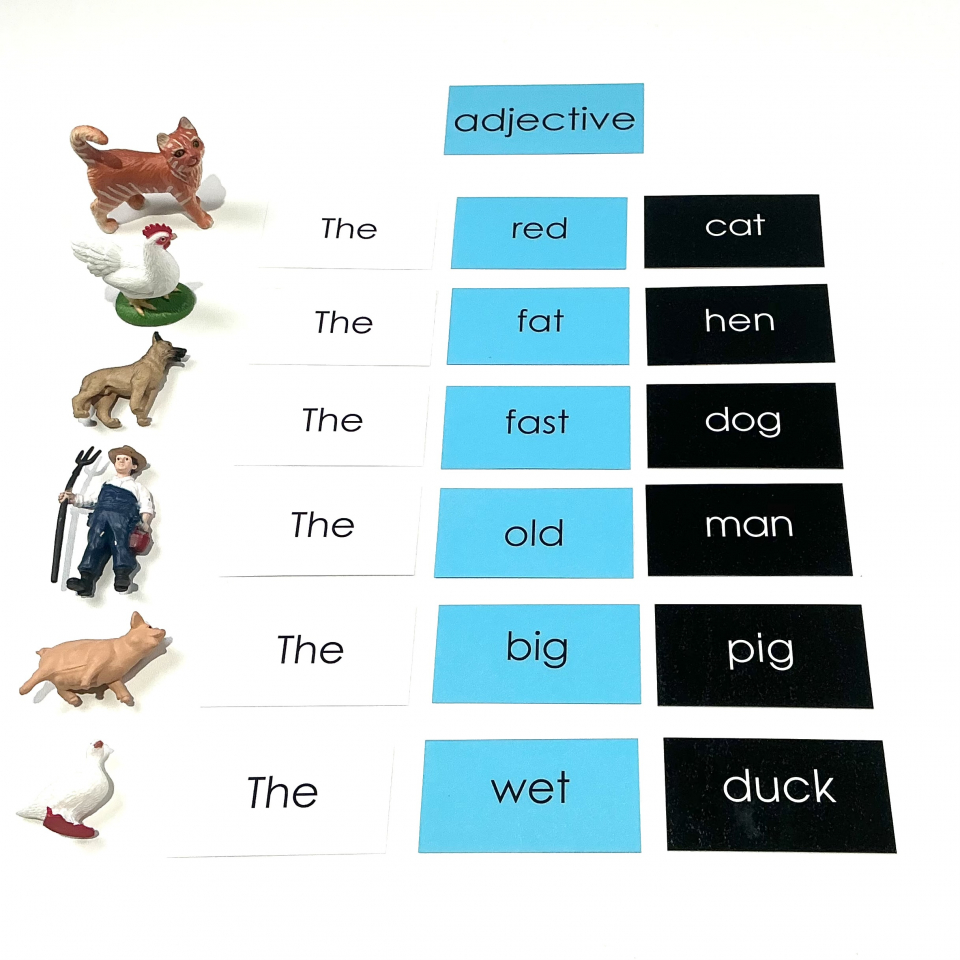
For this presentation, the teacher takes the box containing the farm objects, the Noun box, the Article box, and the Adjective box. The child places the objects on the table and arranges the noun and article cards as before.
Then, the teacher introduces a blue adjective card, such as big, and asks, “What do you think is big?” The child chooses the appropriate object and places the adjective card between the article and the noun: the big pig.
The child continues reading the blue adjective cards, placing each one with an object of their choice, and reading every completed phrase.
Then, the teacher places the blue heading card Adjective above the adjective cards and explains that adjectives are always represented by blue cards in these grammar games.
Introduction to the Verb
Before working with the Farm Game, the teacher presents a lively action game. Each child takes a red verb card, reads the word silently, and performs the action. The other children try to guess the word. The game continues according to the children’s interest, giving them an informal introduction to the function of the verb.
The Verb – Farm Game
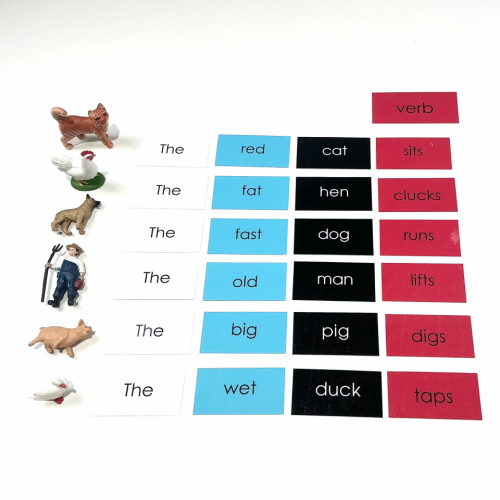
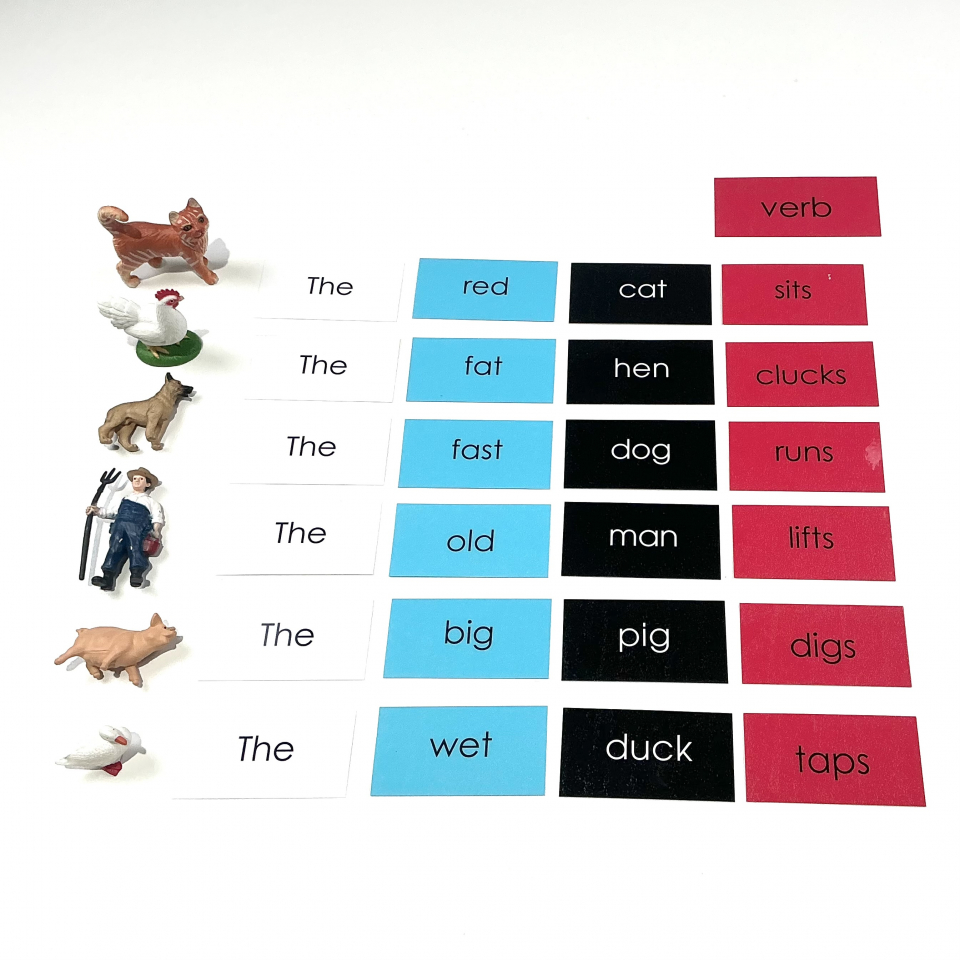
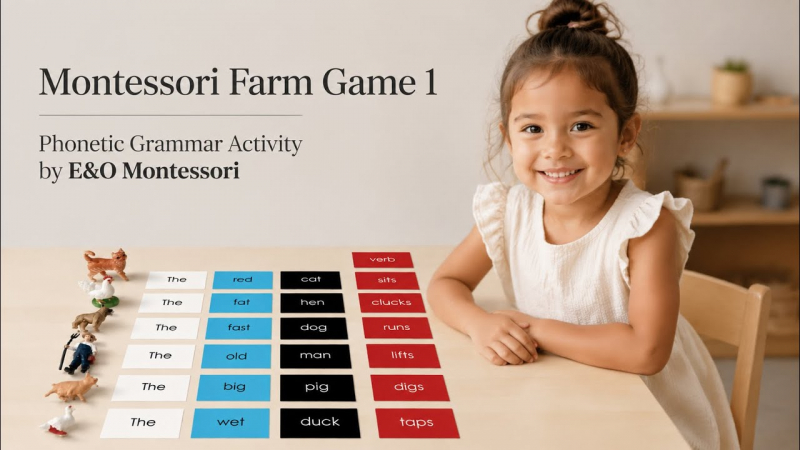
For this presentation, the teacher takes the box containing the farm objects and the Noun, Article, Adjective, and Verb boxes. The child places the objects on the table and arranges the noun, article, and adjective cards as before.
Then, the child takes one red verb card at a time from the Verb box, reads it, and places it after the corresponding noun card. The child reads the complete sentence, such as The big pig digs or The fast dog runs.
The child continues reading and arranging the verb cards to form complete sentences. Then, the teacher places the red heading card Verb above the verb cards and explains that verbs are always represented by red cards in these grammar games.
When the child is ready for more advanced vocabulary and the introduction of the adverb, continue with our Farm Game 2 – With Adverb.



Reviews for Farm Game 1 - Phonetic